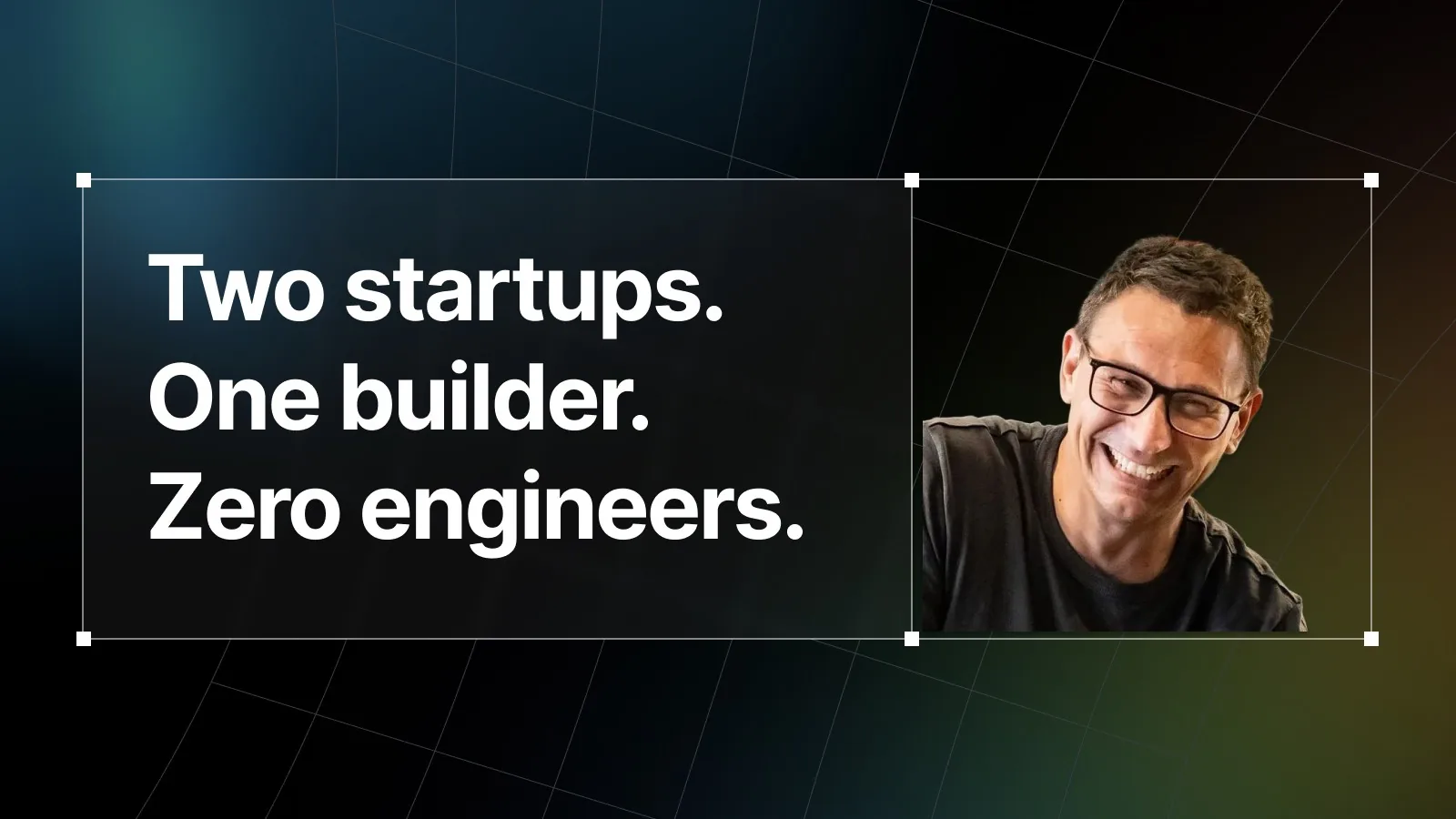

Simon Berg has spent his entire career at the collision point of creativity and technology.
He grew up in the UK, left school early, and joined a creative agency at 17 as the tea boy. Over nearly two decades, he helped transform that shop from a traditional print production house into a modern creative agency spanning print, digital, video, and photography, eventually running it as CEO.
That evolution pulled him into software.
He started building products to solve agency problems, sold the agency to PE, then moved to the U.S. to launch his next chapter: Ceros, an interactive content platform.
Here's the short version of that story:
- Took Ceros from ~$30K ARR to ~$60M ARR over 12 years
- Grew to nearly 400 employees
- Hit a valuation of around $500M
- Sold 58% of the company in 2020
Through all of that, the mission stayed the same:
"Unlock creativity with liberating technology."
When the AI wave hit, Simon wanted to reinvent the company around an AI-first, creativity-first future. When that vision didn't fully align, he did what real builders do: he left to create something new.
Today he runs MSH Studios (Make Shit Happen), an incubator, consultancy, and agency focused on AI strategy and the intersection of AI and creativity. MSH prototypes products rapidly for startups and incubates its own, including Frame My Home and Spellbound.
Bolt is the engine behind both.
Discovering Bolt: from "no-code" to "vibe creating"
Simon wasn't hunting for a single feature. He was answering a fundamental question: What happens when deep creativity meets this new generation of AI tools?
Bolt.new seemed like a way to answer that.
"Bolt felt like the first tool that could consistently take the ideas in my head and turn them into working reality in a fraction of the time"
Company 1: Frame My Home
Frame My Home started as a small, almost throwaway idea: a way to connect the physical and digital worlds through AI and creative automation.
What Frame My Home does
Frame My Home lets you turn a home (or pet) into a framed piece of art using nothing more than an address or a single photo.
- Enter an address or upload a photo
- Bolt-powered agents:
- Search the web for high-quality, publicly available images (Street View, Zillow, etc.)
- Evaluate the results and choose the best shot
- AI transforms that image into multiple artistic styles: pencil sketch, watercolor, oil painting
- The user picks style, frame, and size, sees a fully framed preview in about a minute, and checks out
On the backend, Frame My Home plugs into a printing and fulfillment partner:
- Print, frame, package, and shipping are fully outsourced
- Orders typically arrive in 4-8 days
They've also expanded to pets, where early data shows even higher conversion: people may have one good house photo, but they have hundreds of pet photos.
"People are cash rich, time poor. We remove all the friction. No hunting for artists, no trips to Michaels, no manual framing."
How Bolt powers Frame My Home
Bolt is the primary build environment:
- Frontend and UX: A polished, conversion-optimized experience that doesn't look "vibe coded"
- Backend logic: Address ingestion, image search, AI transformations, style variants
- Agents: Automations that choose the best home image and generate the outputs
- Checkout and operations: Stripe integration and all the flows that make it feel like a finished product
"Bolt turned an idea that would've needed four people, a couple hundred grand, and five months into a side project we shipped in about a month or two with a tiny team"
The product is live, stable, and generating revenue.
"Our biggest win so far is this: Frame My Home is real. It's live. It can scale and generate passive income without a massive team. Now it's about unlocking distribution."
Company 2: Spellbound
Spellbound is the opposite of a big visionary brainstorm. It was born out of a very specific annoyance in Simon's house.
Every week, his 8- and 9-year-old kids came home with paper spelling lists. Just lists of words the kids had to learn.
Mastering these lists week after week was stressful, time-consuming, and frustrating for everyone. And for someone who never thrived in traditional academic environments, Simon recognized rote memorization just wasn't clicking for his kids.
So he built a solution in Bolt over a weekend.
What Spellbound does
Spellbound turns those paper lists into a playful, AI-powered learning environment.
- Scan a spelling sheet or speak a list of words
- Spellbound instantly converts it into:
- Practice lessons
- Tests
- Playful games: aquariums, pizza builders, sentence challenges, etc.
- Kids learn through repetition, visuals, and audio, which is much more engaging than staring at a piece of paper.
When he first built it, it took 4 or 5 hours. It looked rough but it worked. His kids used it for months.
Then he turned off the API key while doing some cleanup, and his kids were furious.
"My kids completely lost it. That's when I realized this wasn't just a toy. It was genuinely useful and loved"
So he cleaned it up, added Stripe, improved the UX, and turned it into a real product in about a week.
What's inside the Spellbound product
All built in Bolt:
- Core app: scanning worksheets, creating word lists, interactive practice, and tests
- Games: multiple visual, audio-rich modes all tied to the same word sets
- AI tutor: in-app character that guides, encourages, and explains
- Voices and personas: kids can choose characters (e.g., King George, Blood Drop) powered by 11 Labs
- Backend and subscriptions: user auth, payments, lesson storage, progress history
- Marketing stack:
- Email automations and templates
- KPI dashboards for users, activity, and funnels
- Support chat and content management
"Bolt's like a startup in a box. Product, backend, subscriptions, ops, even marketing inside one environment."
The big win
After a LinkedIn announcement, a leader at a major UK-based parent network (millions of parents, primarily a content and community business) reached out.
They wanted to partner. They'd be the distribution engine, Spellbound would be the product.
Together, they're exploring whether this can scale quickly with a built-in audience, and possibly expand into a full suite of AI-powered education tools.
"That happened simply because the product existed and was public. If you're brave enough to build and ship, opportunities can find you."
What Bolt changed for Simon and his companies
Across MSH Studios, Frame My Home, and Spellbound, Bolt changed how Simon builds:
- Team size: From needing 4 or 5 people per idea to just Simon and maybe one other person.
- Timeline: From 3 to 6 months for a first version to a week or two to live product.
In his words, Bolt behaves like:
- a 10x developer
- a 4x UX designer
- a 4x UI designer
"I use other vibe coding tools, but I always gravitate back to Bolt. It sits in a rare sweet spot between the art and science of building digital products."
Most importantly, it changes who gets to create something they can monetize.
"I can reliably manifest ideas that would've been impossible, or wildly impractical, without a large team and significant funding. The future belongs to the 'ideas person' who can move fast. Bolt changes the equation."
The takeaway
Frame My Home and Spellbound are real, live, revenue-generating products built by a tiny team at MSH Studios, with Bolt at the center.
- Frame My Home: a new way to turn homes and pets into AI-generated, framed art
- Spellbound: an AI-powered spelling companion turning weekly worksheets into joyful practice
- MSH Studios: an AI-first incubator and consultancy shipping products at a pace that would've required entire departments a few years ago
All powered by the same belief that's driven Simon's whole career:
"Creativity matters. Bolt just makes it possible to ship more of it, faster."