If you've been using Opus 4.6 in Bolt, you already know it's powerful. But you've probably also felt the friction, reaching for a top-tier model every time you need to spin up a component, fix a bug, or wire up an integration. The heavy stuff justifies it. The everyday work? That's 90% of your day, and it deserves something built for the pace.
That's Claude Sonnet 4.6. Opus-class capability for your everyday work. And inside Bolt, it changes everything.
Opus-class capability without the Opus price tag
Previous Sonnet models were good enough for straightforward tasks. But the moment you threw something complex at them, a multi-step feature spanning front and backend, a refactor touching a dozen files, you could feel the ceiling. You'd switch to Opus anyway, or spend time hand-holding the model through steps it should've handled on its own.
Sonnet 4.6 doesn't hit that ceiling. It's the most agentic Sonnet Anthropic has ever released. It proactively plans and executes tasks, parallelizes work, and handles complex features without needing you to intervene at every turn. For the vast majority of your coding work, you're getting Opus-quality output at a price point that makes sense for all-day use.
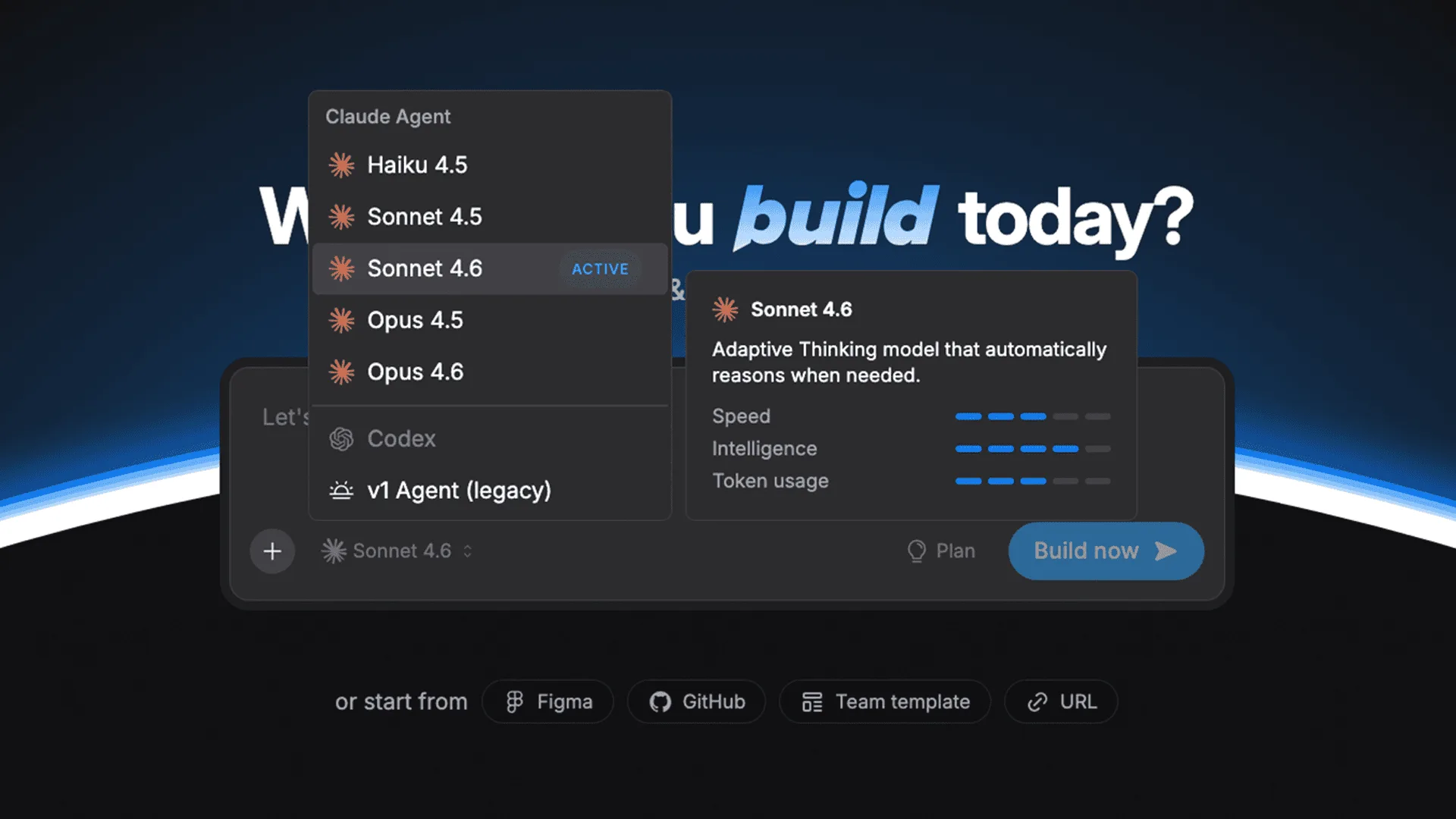
What actually changed
The reasoning got real. Sonnet 4.6 can hold a complex plan in its head and execute across multiple steps without losing the thread. The kind of interconnected, multi-step work that previously demanded Opus 4.6 - building a feature end to end, making coordinated changes across your stack, it just handles it.
It's the most agentic Sonnet yet. This is the big shift. Sonnet 4.6 proactively executes tasks, delegates to subagents, and parallelizes tool calls. Instead of waiting for you to manage every step, it plans ahead and acts. That means less babysitting and more building.
Same price, dramatically more capable. Speed and cost determine whether you actually use a model as your daily driver or save it for special occasions. Sonnet 4.6 is built for the volume of work real teams do every day, approaching Opus-level intelligence without approaching Opus-level costs.
Why Bolt + Sonnet 4.6 is the move
A great model is only as good as the environment it works in. Bolt is already built for how builders actually work. Describe what you want, and it builds. Pair that with a model that reasons through complex features without breaking down, and you've got something that changes your velocity.
Think about your typical day. You're not architecting a moonshot every hour. You're spinning up components, adding integrations, fixing bugs, building out flows. That work deserves a model that's skilled enough to handle it well and affordable enough that you never think twice about reaching for it.
Sonnet 4.6 in Bolt is that model. Opus isn't going anywhere, for the most complex, highest-stakes work, it's still the peak. But for everything else, and "everything else" is most of what you do, Sonnet 4.6 is noticeably better than what came before.
The best tool isn't the most powerful one. It's the one you actually reach for. With Sonnet 4.6 in Bolt, you're reaching for Opus-class capability every time, without the tradeoff.
Try it now at bolt.new
Tag us on X and tell us what you're building!