Snapshot
- Company: VISION-LINK AI HUB, Nigeria: a bootstrapped deep-tech startup founded by Buhari Salisu.
- Use case: the entire cloud backend plus caregiver and user web dashboards for AI smart glasses that assist visually impaired people.
- Before: vendor quotes over ₦6,250,000 ($4,000+) and four to six weeks, against a budget reserved for hardware.
- After: a working first version, funder-ready, built in-house in a few hours.
- Key metric: four to six weeks of vendor time collapsed into a few hours of design sprint.
"His face completely lit up"
The moment Buhari Salisu keeps coming back to happened during an early user test.
"The moment the prototype successfully identified an incoming obstacle and read a sign out loud in his native language, his face completely lit up with joy and confidence. He told us that for the first time in years, he felt a true sense of independent awareness of his surroundings."
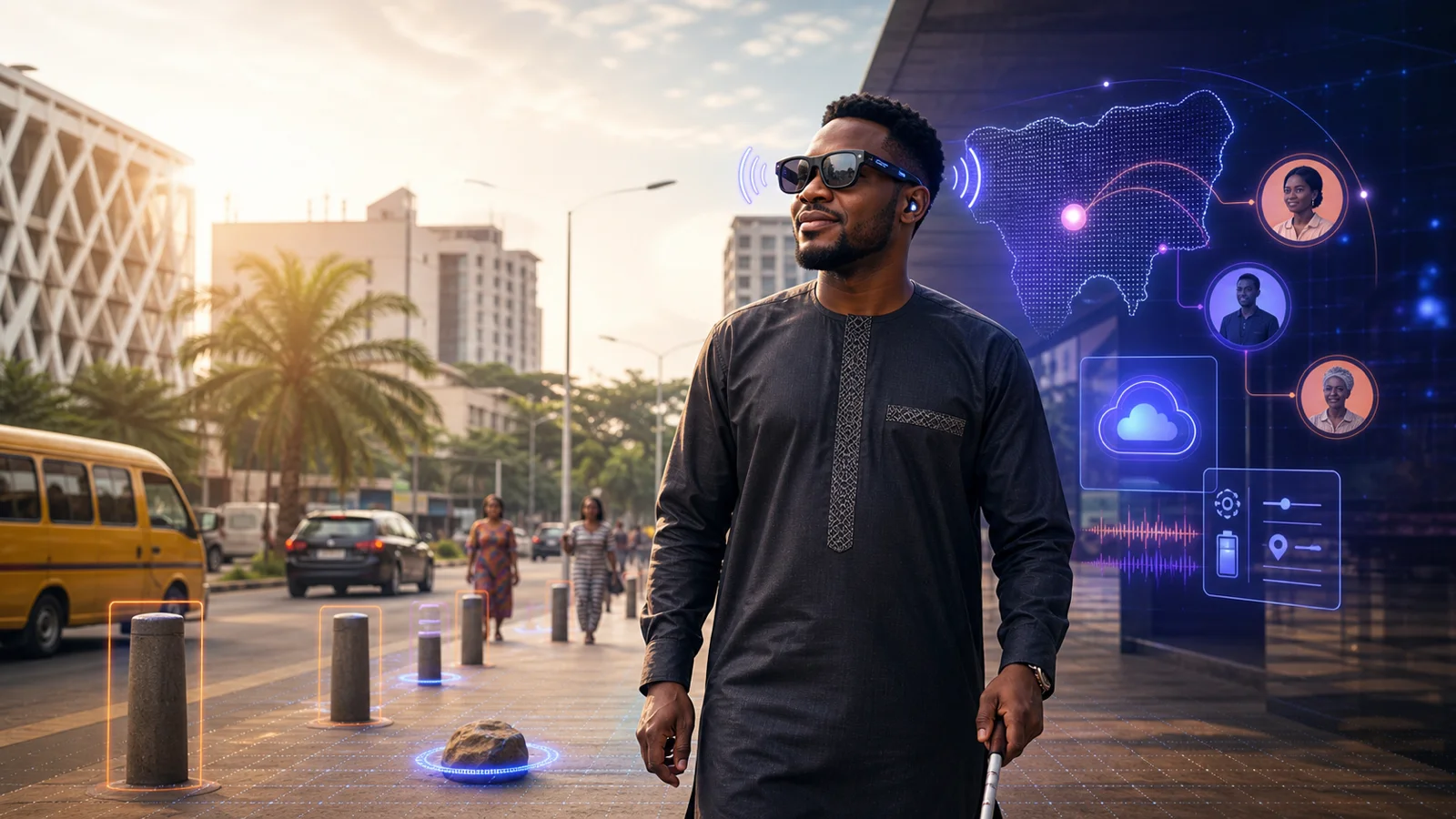
Buhari is the founder and tech lead of VISION-LINK AI HUB, the Nigerian deep-tech startup building smart glasses for visually impaired people. The glasses do their thinking on-device: real-time environmental awareness, obstacle detection, object recognition, and audio feedback in the wearer's own language. That language can be English, Arabic, or Hausa.
The glasses work offline. Buhari wanted to make sure people living in rural communities where connectivity can't be assumed could still benefit from the technology.
"Many existing assistive technologies are either prohibitively expensive, require high-speed internet, or aren't built for the infrastructure of emerging markets. I realized that with advances in edge AI and computer vision, we could build an affordable, wearable solution that acts as a real-time digital eye working completely offline."
$4,000 for the dashboards
The glasses live on the edge, but the product around them needs a cloud. Caregivers and family members need a portal to monitor device status, manage emergency contacts, and configure settings for the person wearing them. When Salisu priced that build with vendors, quotes came back above ₦6,250,000, more than $4,000. Delivery would take four to six weeks, plus the requirements back-and-forth that precedes any outsourced build carries its own tax in time and potential frustration. For a bootstrapped team, that quote equaled the hardware budget. Every dollar spent on dashboards was a dollar not spent on field testing and gathering real-time data from users.
Speed, capital, and control
So he built it in-house on Bolt.new, an AI app builder, for three reasons he lists like a pitch slide: speed, capital, and control. Bolt.new provided instant access to prototyping, testing, and iterating the caregiver dashboard in days.
"As an early-stage startup, keeping development in-house saves significant capital, allowing us to allocate more resources toward hardware R&D and field testing."
Keeping the build inside the company also kept the data privacy, security, and split-second behavior of an assistive-health product in his own hands.
The team used Bolt.new to build the entire cloud backend plus the caregiver and user dashboards: a portal with regional tracking grids, live telemetry, Hausa audio configuration, and emergency-contact management.
The first working version came together within a few hours of the design sprint. The demo simulates a full operational load, with live-metric tables tracking 1,254 simulated system alerts across regional nodes at 9ms latency. What surprised him was the finish: the dashboard came out looking like a production control room, which is a great UX and helps position the product as something of interest to investors.
Built to travel
As of August 2026, VISION-LINK has a working prototype. Navigation and obstacle detection are validated on the glasses; the cloud pipelines and companion dashboards are live. Salisu has put it in front of funders and grant networks as a concrete proof-of-concept. The company is bootstrapped and raising: early-stage grants, pre-seed funding, and strategic partnerships to scale the hardware.
Next comes wearable hardware integration, then real-world field trials with visually impaired users, then an MVP for commercial pilots. The offline edge-AI framework underneath is built to travel further than assistive vision: local healthcare diagnostics, agricultural tools, industrial safety.
His advice to other deep-tech founders reflects his dedication to making a difference:
"Don't just build complex tech for the sake of it. Solve a pressing, foundational problem that changes lives."