Highlights
- Company: Rootful Media, the Durham, North Carolina umbrella for Angela Hollowell's work: the Please Hustle Responsibly newsletter (on beehiiv), the Honey & Hustle podcast, and a decade of filmmaking and writing.
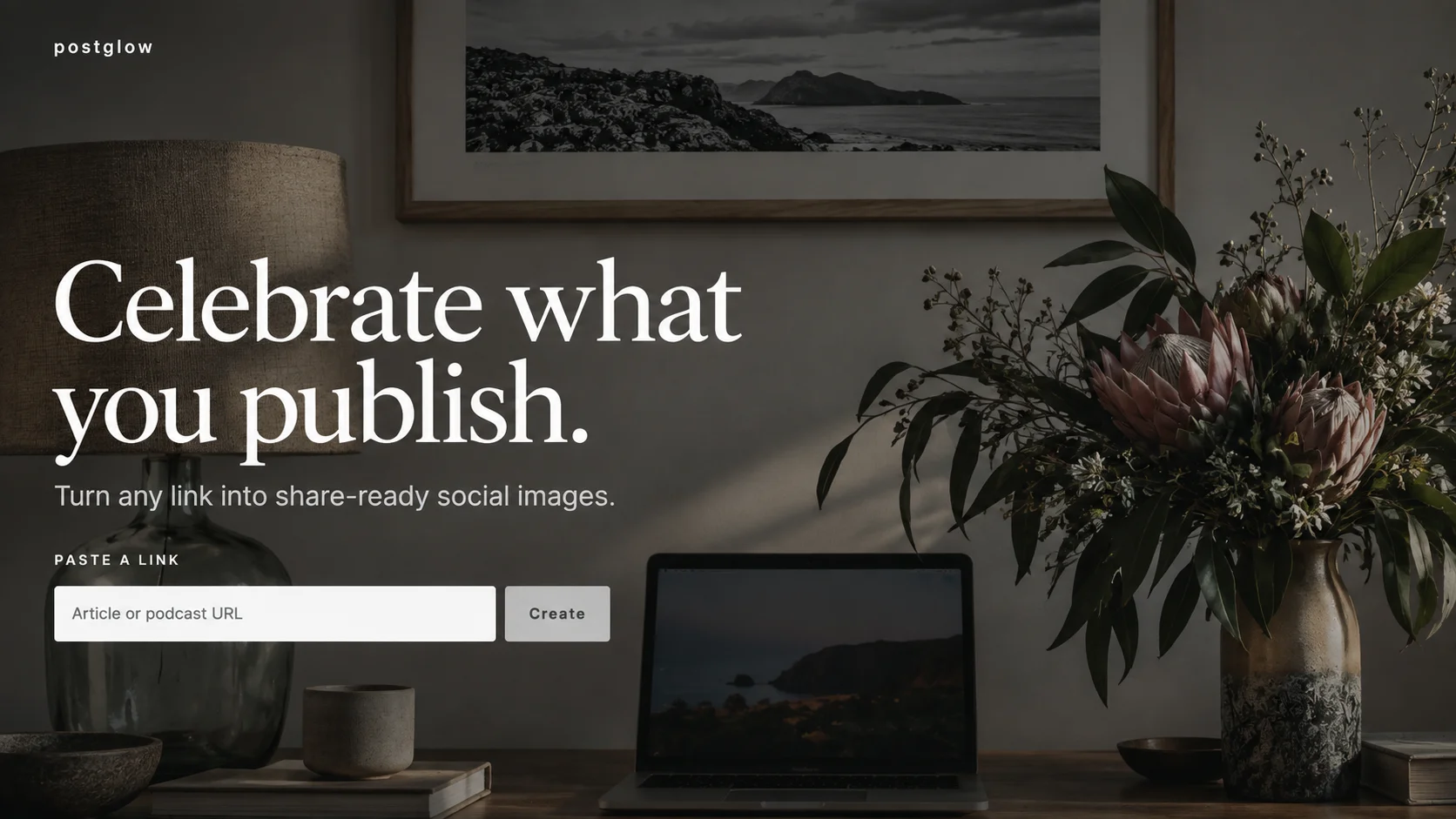
- Use case: two products for creators, both built on Bolt.new. Postglow turns any article or podcast RSS feed into shareable social images. Honeyblocks is a library of reusable, brand-colored newsletter blocks.
- Before: share images were auto-generated only if you published on Substack; newsletter design meant copying HTML blocks between old issues at 3 a.m.
- After: Postglow generates article and podcast images plus month, quarter, and year-in-review "receipts" from a link or RSS feed; Honeyblocks saves and recalls custom blocks into any issue, no code required.
- Key metric: 90 days into building with AI, she entered a Hatch-a-thon and won the People's Choice award with an app built on Bolt.new.
Talk to it, get software back
Angela Hollowell watched the crypto wave roll through her corner of Twitter and let it pass. NFTs, web3: not for her. Then vibe coding came through the same feed and stopped her cold, because the pitch was different. "I was like, hold on. I'm a writer. You mean I can just talk to something, and it gives me something back. That's great," she said.
She's a filmmaker and writer in Durham, North Carolina. Six years of full-time freelancing, ten in the work. Rootful Media is the umbrella for the Please Hustle Responsibly newsletter, the Honey & Hustle podcast, and documentary and photography work for clients. Words are her trade. A technology you talk to was the first one that spoke her language.
She learned fast that talking well isn't the same as prompting well. "As soon as you think you can communicate well, vibe coding tools will tell you otherwise," she said. Ninety days in, she entered a Hatch-a-thon anyway, building a SaaS tool for a local business owner.
"I entered a hackathon. And I won the people's choice award for that. So I guess I caught the bug."
The winning app ran on Bolt.new.
An idea note is not a product line
The pull to build persisted, but Bolt builds didn't pay the bills; freelancing did, and she set the tools down. What pulled her back was a plan she'd already set in motion. In 2024, with freelance work peaking around 60% of her income, Angela decided to invert the ratio and make original media and her own products the engine.
Every creator has the note she has: a running list of app ideas, growing and going nowhere. "Bolt gave me that freedom to experiment and play around," she said. "Whereas before, I just wouldn't. All my ideas would get stockpiled in this idea note and just sit there."
Two ideas got out of the note. Both came straight from her own writing and publishing workflow, and both shipped.
Honeyblocks: build a good-lookin' newsletter
The first idea announced itself at 3 a.m. Angela's newsletter runs on beehiiv, and over the years she'd tuned her templates issue by issue: where ads perform, where callouts land, where community news sits. Mixing those sections into a new issue meant digging through old articles, copying blocks, pasting them across. "It's 3am, and I'm tired, there's just no way that I can make enough templates," she said. "And so I was like, yeah, Honeyblocks needs to happen."
She asked the beehiiv team on Slack whether user-made template sharing was coming. It wasn't. So she built the thing herself: Honeyblocks, a library of HTML newsletter blocks that need no code, take your brand colors, and save for recall into any issue. Her community had been asking "how do you make your newsletters look like that?" for months. Now there's an answer that doesn't require her.
"I've been with beehiiv for a couple years. I'm like, I think I can make something sexier."
Postglow: receipts for writers
The second idea started as envy, the productive kind. Substack auto-generates polished share-ready images the moment you hit publish. beehiiv doesn't. Neither do Kit, MailChimp, Flodesk, or MailerLite. Writers on every other platform either wrestle with a Canva template per article or post a bare link and hope.
Postglow closes that gap for everyone: paste an article link or an RSS feed, hit load, and shareable images populate, ready to download and post anywhere. The feed matters because it unlocks a writer's whole catalog: reshare the piece that's suddenly timely again, or preview the next one alongside the last.
Then came the part she cares about most. Her friend Pete Cybriwsky had built Strava Receipt, which turns a runner's workout data into an itemized paper receipt, and it crystallized what Postglow should be.
"People need receipts for their work. Writers put in so much time, so much energy, so many words a week. I wanted it to be a celebration of what we've done."
So Postglow got a second mode: month, quarter, or year-to-date review images, a wrapped-style celebration of a writer's output. When she wanted the same for podcasters, she pressed Bolt.new's plan button, asked whether it could work for podcast RSS feeds, and built it.
One thing Postglow refuses to do: generate AI imagery. The images build from the article thumbnail or the podcast cover art, the visuals the creator already made. "I think AI imagery can suck the soul out of what you created. This is my way of trying to give you a little bit of that soul back," she said. She also built and then shelved AI-written captions and direct social posting; the captions weren't good enough, and the login plumbing wasn't worth it yet. She shipped the simplest, cleanest version instead.
Taste is the spec
Angela's build process starts before the software does. "I started on pen and paper. I would take a picture of a notecard with my terrible scribbles and sketches and I would put them in Bolt and say, make me this. And it works, surprisingly well," she said. Sketch, photograph, prompt.
The polish costs more than the prototype. Getting Postglow functional was the easier half; making it intuitive is where she spends time. She reworked the color scheme three times and burned through a month of Bolt.new credits on design alone. She screenshots work-in-progress and asks Claude, the AI assistant, to critique the design, then takes what survives her own eye.
Her standard doesn't bend:
"If it doesn't feel easy, even though I think it's easy and technically it should be easy, then it doesn't matter."
That's the texture a decade of client work buys. She's drawing on The Atlantic and The New Yorker's article graphics, on Spotify Wrapped, on every app whose details she's admired. The tools are new. The taste is earned.
First ten users
Honeyblocks has no paying users yet, and the plan is unglamorous on purpose: get the first ten beehiiv users, prove the product works as intended, then see which platforms want it next. She's confident in the pricing and candid that marketing a SaaS is a new skill. She's a filmmaker; the video marketing is coming.
Her advice for creators sitting on their own idea note skips the hype entirely:
"Worry less about AI, focus more on the basic principles of marketing and running a business. You know what you want to make. AI just provides the tools to get you there."
Build the thing your work deserves
The idea note isn't a product line. Start free on Bolt.new and get one idea out.