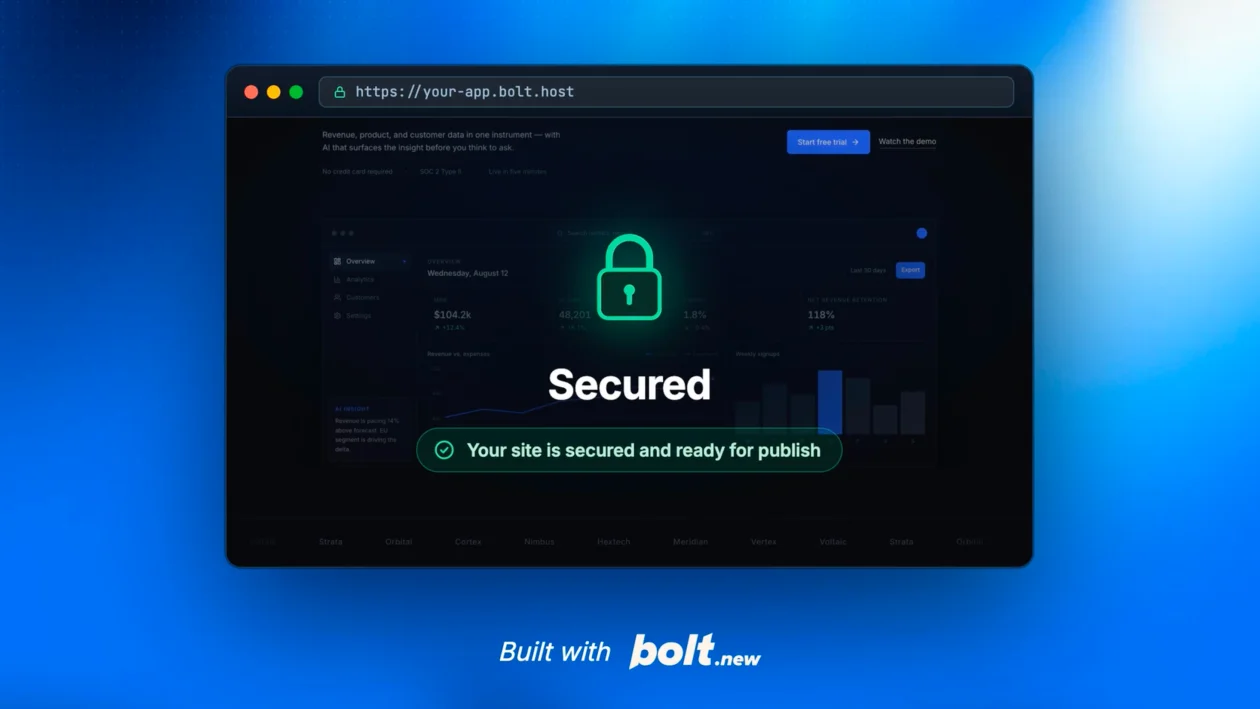

Every Bolt app can now get a deep security review before it publishes. It scans your project, writes the fixes, and hardens the app before it goes live.
Here is why that matters. Raw AI-sourced coding is far from secure, and this is a known issue. Over the past two years, roughly 45 percent of AI-generated code introduces vulnerabilities (Veracode, 2025), and that number hasn't budged despite models growing orders of magnitude more capable. Which is partly why Bolt.new has always integrated security guardrails into the platform: reasonable defaults for databases, authentication, and deployment, plus vulnerability scanning since day one.
But guardrails alone aren't enough. The real friction point isn't capability. It's workflow.
Most security tools ask builders to slow down: read a report, triage findings, decide what to fix. That's a context switch that conflicts with how Bolt works. You describe what you want, Bolt builds it, you ship.
Bolt's existing security review closes some of that gap, but it still asks you to review findings and decide what to fix yourself. That was the right first step. It's not the last one.
The data
Bigger models don't write safer code. Coding-specific models don't either.
What matters instead is the fix rate. Endor Labs found AI agents pick safe dependencies only 20 percent of the time on their own. With security tooling in the loop, that jumps to 57 percent (Endor Labs, 2025). That's the difference between a coin flip and a real safety net.
Georgia Tech traced 74 confirmed vulnerabilities to AI-generated commits (Georgia Tech Vibe Security Radar, 2026). Six per month in January. Thirty-five per month by March, and growing.
How it works
You build an app. When you're ready to publish, you run the security agent. It scans your project, identifies issues (broken access control, secrets in code, business logic gaps), writes the fixes, and applies them in one pass. Your app publishes, secured.
No report to read. No tickets you'll get to later. Just a short rundown of what got fixed. It's free, and it never touches your tokens: that's a cost Bolt eats.
Run it on every publish, not just the first one, because the risky change is usually the one you made at 2am.
Why this works
The old model: run a scan, get a report, decide what to fix. That works if you have a security engineer on staff.
Most Bolt builders don't. They're moving fast, often building their first app, with no security team and no time to triage a 50-finding report.
So we put a security engineer into the platform itself.
We built security as a platform feature instead of a reporting tool, the same way Bolt handles databases (you don't write SQL, Bolt does) or deployment (you don't manage infrastructure, Bolt does). You describe what you want, Bolt builds it securely, and you ship.
What gets fixed
The audit covers the categories where AI-generated code is weakest:
- Access control: your app checks who can see what, and who can do what. Bolt makes sure those checks exist.
- Authentication: sign-ins, sessions, and password handling that hold up instead of just working.
- Business logic: if your app manages transfers, approvals, or state changes, Bolt ensures the rules hold.
- Database policies: Row Level Security and permissions that allow exactly what they should, nothing more.
- Information disclosure: Bolt strips secrets from client code and makes error messages generic, so sensitive data doesn't leak.
- Secrets: API keys, database credentials, tokens: anything that should stay private.
- Injection and XSS: cross-site scripting, SQL injection, command injection, template injection, race conditions, the classic ways an attacker sneaks commands into places that should only hold data. Modern frameworks prevent most of these by default. Bolt verifies they're being used.
Each finding comes with a fix. Some are one-line changes; some require rethinking how you structured the app. The security agent applies the mechanical fixes automatically and flags the architectural ones for you to review.
Already running security tools?
The agent is a first pass, not a replacement. If your team runs tools like Socket, XBOW, or JFrog, Bolt scans and hardens your app before it ever reaches the enterprise tooling in your CI/CD pipeline. Your stack keeps its depth. Your first line of defense just got earlier.
The bigger picture
For a year, the industry has debated how to make AI-generated code secure, and the answers have mostly been about testing better, scoring better, benchmarking better: measuring the problem more carefully.
Measurement isn't the bottleneck. Friction is.
Publish is too late to catch a problem. Mid-generation is too early, since you haven't finished iterating. The moment that matters is the one in between: after you've said what you want and Bolt has built it, before it goes out into the world. That's where security lives now.
Try it
It's live now. Open any Bolt project, hit publish, and you'll see a "Run security audit" button in the publish menu.
It takes two to three minutes per app. You'll get an overview of the fixes it applied and a score for how much risk got mitigated. Then your app publishes, safer than it went in.