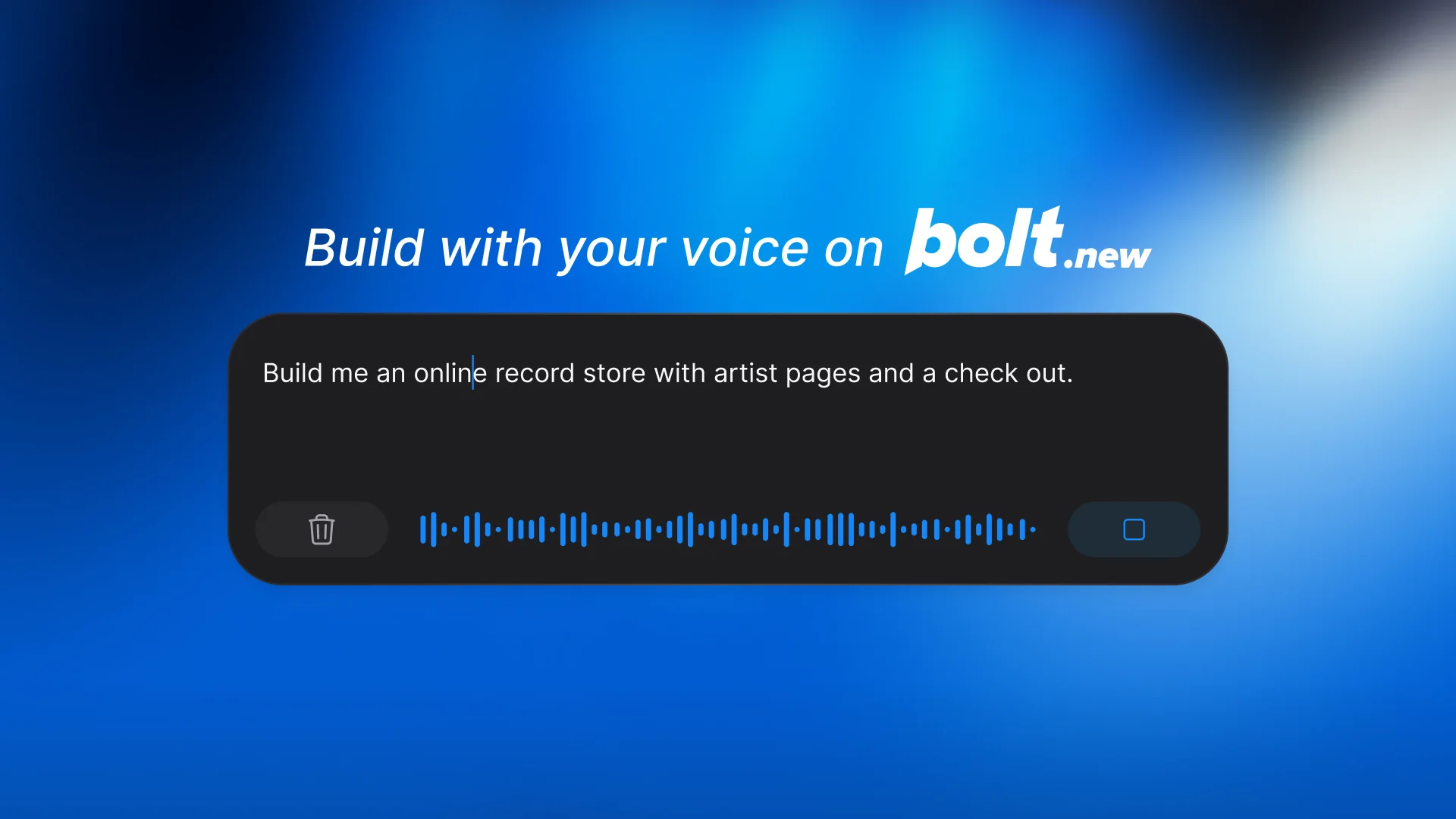

Your keyboard just got demoted. Dictation is live in Bolt.new. Hit the mic, say what's on your mind, and keep talking until the whole idea is out of your head.
What is dictation in Bolt.new?
Dictation lets you speak your prompt instead of typing it. Click the mic in the prompt box, describe what you want, and Bolt.new turns your speech into the instructions that build your app. It works anywhere you'd normally type: starting a new project, working through updates, or adding new functionality or depth.
Explain what you want to accomplish the same way you'd describe it to a person (no pressure here, this isn't a TED talk). Bolt.new strips the false starts, the filler, and the thought you said twice.
Why does talking beat typing?
Speed is the obvious answer. Researchers at Stanford and the University of Washington measured speech against a phone keyboard and clocked it at 2.93 times faster in English (ACM Digital Library, 2018).
The better answer is what you're willing to include when saying more costs you nothing. Typing makes you ration. You skip the background, drop the edge case, and leave out the detail about how your customers actually pay you, because every extra sentence is more work. Talking removes that tax. You don't have to distill your thoughts and ideas with dictation.
Detail is what the AI builds from, and talking is how you give it more.
Does more detail make a better app?
Yes, and the research puts numbers on it. One 2025 study ran coding tasks at rising levels of prompt detail and watched one model's accuracy climb from 28% to 86% as the instructions got more specific (Northeastern, 2025). The same study found that the biggest gains came from spelling out what goes in, what comes out, and what should happen when something unexpected shows up.
The catch is that the AI won't tell you what it's missing. Carnegie Mellon researchers found that models struggle to tell a well-specified request from an underspecified one (Carnegie Mellon, 2025).
It doesn't stop and ask. It guesses, confidently, and you find out when you look at what it built.
So, give it the things it can't guess. Who uses this. What happens when they click the button. What your business does that makes this different from every other version of it. The richer the detail, the better the build.
What does that sound like out loud?
Here's the same request, typed and spoken.
Typed: "Build a booking system for my salon."
Spoken: "I need a booking system for my salon. We do cuts, color, and treatments, and color takes about three hours so it can't be booked in a 30-minute slot like the others. Clients should see who they're booking with, because most of them have a stylist they stick with. If someone cancels within 24 hours, we still charge half. And I want to see tomorrow's schedule on my phone the second I open it."
Both take about the same effort. The second one produces something you can use on Monday.
How much should you say?
Think about how you'd brief a contractor you're paying to build this. You wouldn't say "I need a booking system" and walk away. You'd tell them your hours, your services, what happens with cancellations, and what you want customers to see first. Same instinct here: the more precisely you describe what you want, the closer the first build lands to what you had in mind.
There's a ceiling, though. In that same study, the gains flattened out: past roughly 100 words of detail, piling on more barely moved the needle (Northeastern, 2025), and the Carnegie Mellon team found that simply adding more requirements doesn't reliably help either (Carnegie Mellon, 2025). The salon description above is about 90 words.
Why is this worth knowing? Because tight, descriptive prompts work well with how AI reasons and builds. Prompt in paragraphs, not novels, for best results.
Does Bolt speak my language?
Yes. Bolt.new understands whatever language you speak. Bolt will build off your native-language prompts.
Try it
Open Bolt.new, hit the mic, and describe what you want to build.
Your next app is one conversation away.