

Jonathan Davis spent nearly two decades in disability education. Then, with no coding background, he taught himself to build software on Bolt and shipped Empowered Applications, an AI-powered e-learning and compliance ecosystem that replaces the spreadsheet-and-PDF patchwork providers had been stuck with. Here is how he did it.
Tutors, agencies, and support coordinators serving adults with intellectual and developmental disabilities rely on a patchwork of tools that weren't built for them. Generic ed-tech platforms push rigid, one-size-fits-all lesson plans built for the average student. Record keeping makes it worse: state and federal funding demands an auditable trail of every learning hour, lesson plan, and outcome, so the work gets held together by hand, in a sprawl of spreadsheets, PDFs, and paper forms.
That leaves adults with disabilities, and the educators who support them, with few good options. Teachers and tutors built what they could from what was available, but cobbled-together systems couldn't deliver the modular learning their students needed, or the documentation their funders demanded.
Expertise Meets Execution
Jonathan Davis spent nearly two decades inside this system and saw the same broken pattern from every angle.
"I've worked across education, disability services, auditing, tutoring, ABA therapy, residential management, respite care, self-directed supports, and educational technology. Many of those roles intersected, allowing me to see the same systems from the perspectives of educators, providers, families, auditors, and administrators. I understood how all the pieces needed to come together, so I built something that fits the space rather than continuing to pull together multiple disconnected tools."
That cross-cutting experience exposed a problem no single tool solved: organizations kept reshaping themselves around software that was never designed for their work. So Davis signed up for a free Bolt.new account and got to work.
He had no software background. What he had was two decades of operational knowledge and a conviction: the people who understand the problem best should be the ones building the solution. Working in Bolt and ChatGPT side by side, he taught himself relational databases, row-level security, API integrations, and application architecture as he went. Months of iteration and countless prompts later, he had turned field experience into working software.
Empowered Applications: The Ecosystem
Davis founded Empowered Applications LLC to build technology, infrastructure, and consulting for the educators, providers, and organizations long forced to bend generic software to specialized work.
Under the Empowered Applications umbrella are four connected branches of the Empowered Ecosystem:
- Empowered Sessions: provider infrastructure for documentation, compliance, billing, scheduling, verification, and oversight.
- Empowered Learning: a learner-focused ecosystem of apps like Quest of the Mind, DriverPrep, and more adaptive tools to come.
- Empowered Classroom: adaptive infrastructure for school programs, supplemental and religious education, and other settings that need more flexibility than a traditional learning management system.
- Empowered Agency: website modernization, workflow consulting, portal development, and digital infrastructure that upgrade an organization's technology and its operations.
Empowered Sessions: An end-to-end educational platform
Empowered Sessions exists because Davis lived the problem it solves. Across the industry, providers manage services using disconnected spreadsheets, scheduling systems, learning platforms, and billing tools that were never designed to work together.
"All the agencies I've talked to, they have no way to audit their tutors' sessions other than having someone sign a piece of paper."
Sessions replaces that patchwork. A tutor logs a virtual session and the platform captures the timestamp, notes, and video recording. An in-person session gets verified through geofencing. When billing is due, the platform compiles verified session records into a ready-to-sign document with e-signature workflows. A process that used to take hours collapses to minutes.
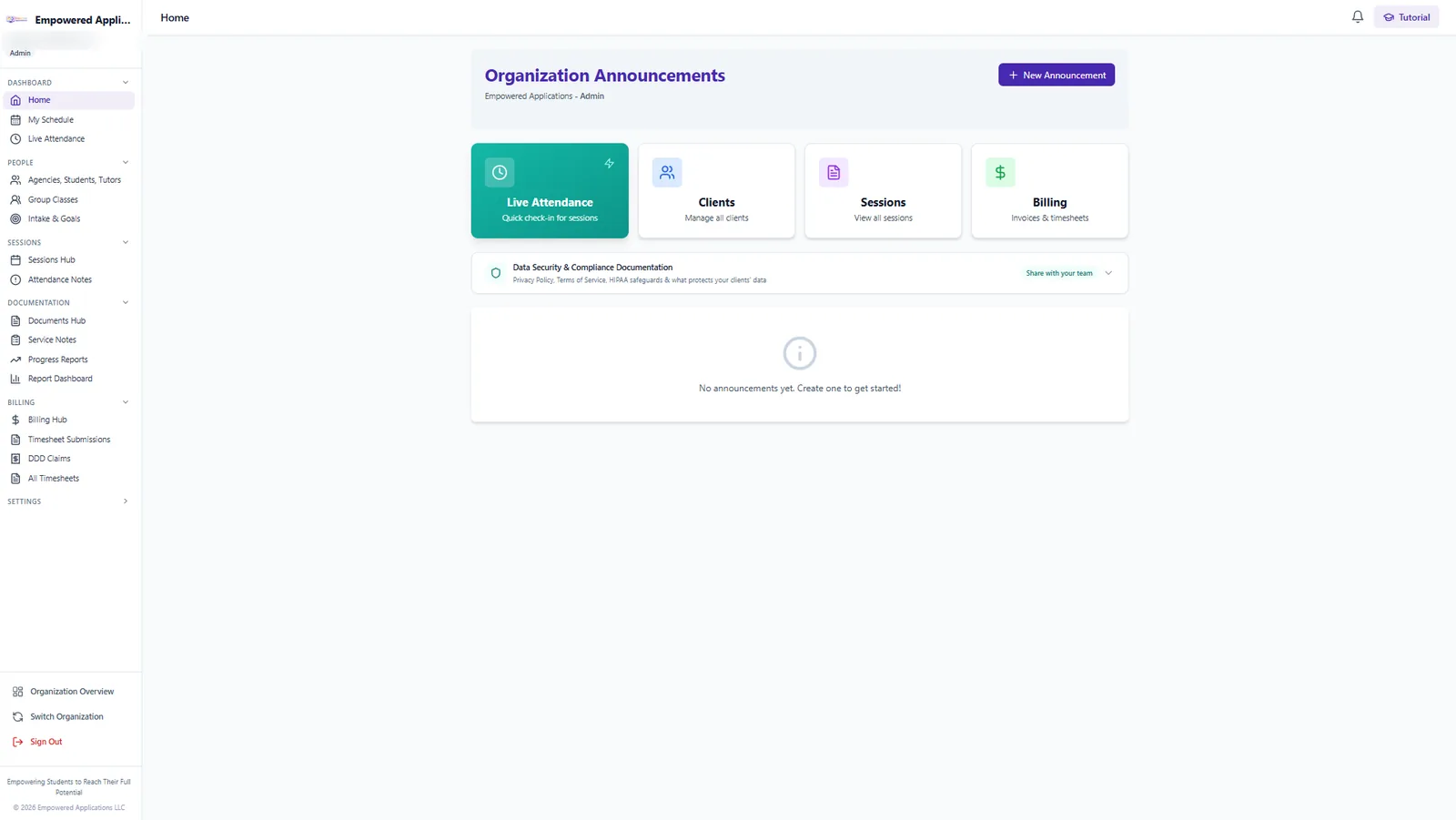
The platform also handles role-based access control with logged justifications for viewing protected information, progress tracking that pulls data from connected learning apps, smart scheduling tied to service authorizations, and white-label branding for each organization.
Empowered Learning: Teaching to the student
On the learner side, Davis built Quest of the Mind, a customizable learning platform covering reading, spelling, math, financial literacy, executive functioning, social skills, life skills, and driver's ed permit preparation.
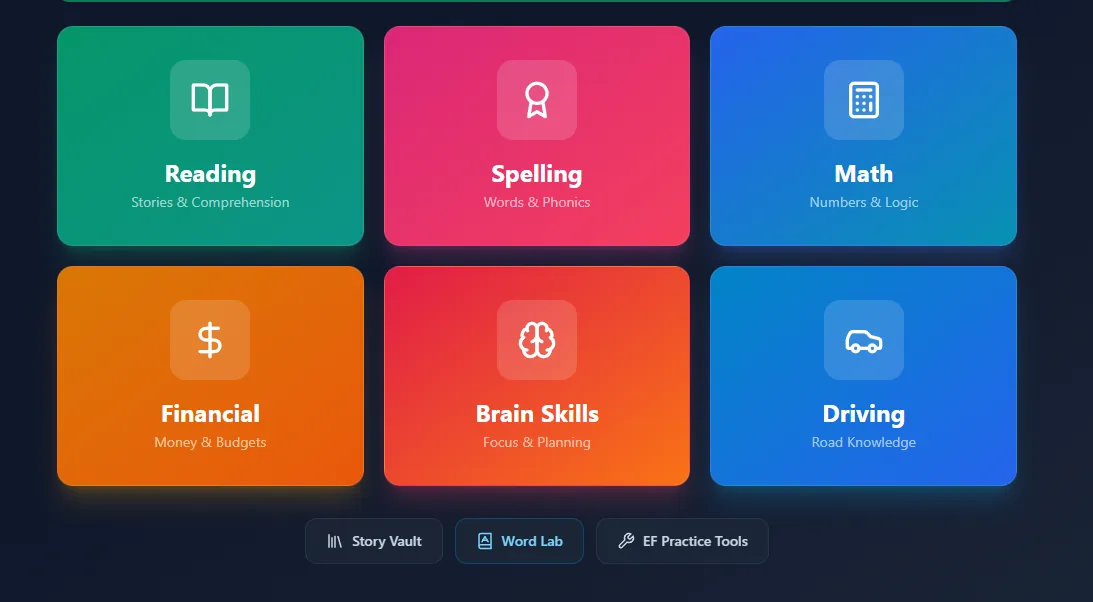
The platform adapts its format to what's being taught. Reading focuses on fluency and comprehension. Spelling uses game-based challenges. Math and executive functioning run through interactive mini-games. Driver's ed follows a chapter-based adventure structure.
An AI-powered lesson generator helps tutors and parents create customized content quickly, but every lesson stays fully editable and educator-controlled. Students move through a Teach-Practice-Battle framework:
- Teach: guided content with text-to-speech and word highlighting for pre-readers
- Practice: scenario-based exercises that reinforce the lesson
- Battle: gamified challenges where students defeat monsters by demonstrating mastery
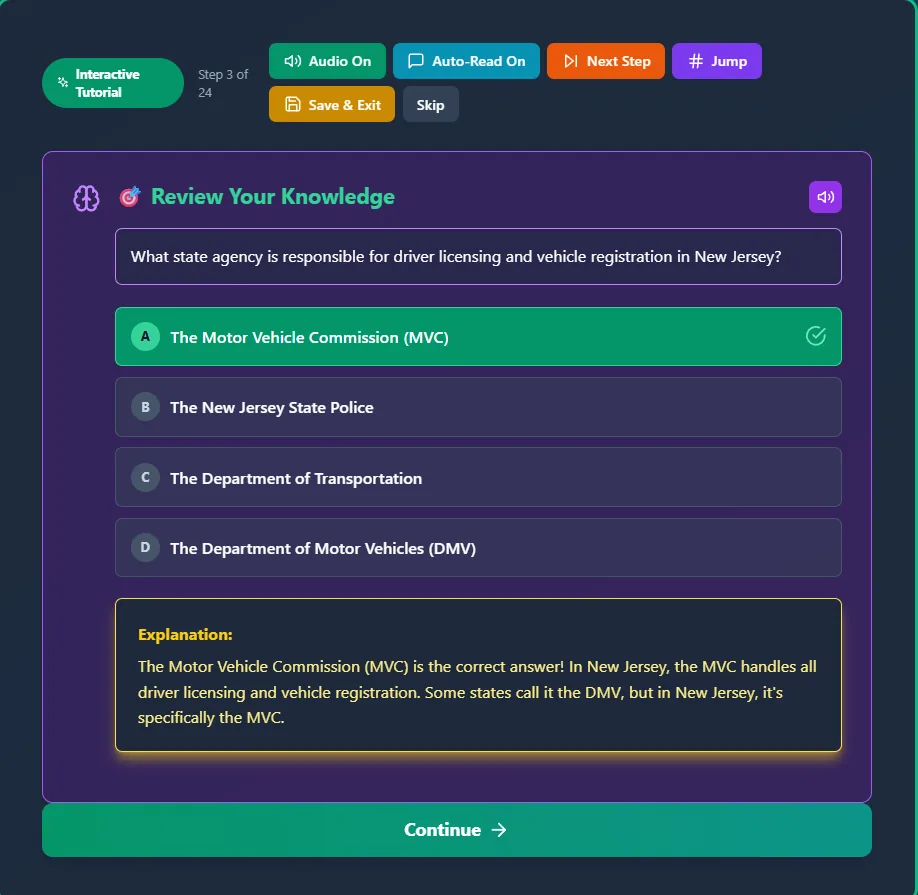
Tutors control what each learner can access. A student who can't yet read follows along with audio and highlighting. A student who needs more structure progresses through a guided sequence. When a student finishes a lesson, that progress lands in Empowered Sessions, tying what was learned to the documentation and billing providers already file.
"We always say in education that a teacher needs to teach to the student. Every individual needs an approach that works for them. It can't be a cookie-cutter process; you need to be able to customize the whole experience."
An iron-clad paper trail
Organizations serving individuals in programs funded through the state Division of Developmental Disabilities (DDD) face rigorous documentation requirements. Every service delivered, every hour billed, every reported outcome must hold up to scrutiny from agencies, funders, and auditors.
The platform builds that trail at every step. Session timestamps and durations log automatically. Virtual sessions are recorded. In-person sessions are geofence-verified. Protected-information access is logged with who, when, and why. Billing documents pull from verified session records.
Davis didn't build this because a product manager requested it. He built it because he's sat in the rooms where documentation gets questioned. He knows what a support coordinator will ask for, what a DDD auditor will flag, and what happens to an agency's funding when the answers aren't there.
From side project to SaaS
Agencies are already implementing Empowered Sessions for stronger documentation workflows, better operational visibility, and audit readiness. Davis designed the platform to stay accessible to the organizations it serves, many of which run on tight budgets while supporting people with complex needs.
"The companies I've talked to? They said, 'Where do I sign up? I can't sign up fast enough.'"
What comes next
Davis continues expanding the ecosystem. He is the founder, designer, developer, tester, and support department rolled into one. Working alongside AI-powered development tools, he moves from concept to deployment at a pace that would have been impossible for a solo founder a few years ago. When an organization surfaces a challenge, Davis can often design, test, and ship a solution in days.